We Tried CopilotKit. Then We Built Our Own AG-UI Chat Layer.
We were building an AI prototyping tool. The kind where you chat with an agent and it writes code, spins up a dev server, and renders your app in a phone simulator. In real time. Streaming text, inline tool call cards, state synchronization, generative UI components. The whole deal.
CopilotKit was a reasonable starting point. It had AG-UI protocol support and React hooks. So we integrated it, shipped a prototype, and started running into friction with the framework.
What We Ran Into
We evaluated CopilotKit v1.50 and v1.51. Here is what we encountered:
- Agent registration issues. Our agent would silently fail to register in certain mount orders. Debugging meant reading through layers of abstraction with no clear error surface.
- Framework lock-in. CopilotKit owns the SSE connection lifecycle. We could not control reconnection behavior, abort signals, or buffer parsing.
- Opaque abstractions. Raw AG-UI events were hidden behind hooks. We needed access to
TOOL_CALL_ARGSdeltas to render inline tool cards as they stream. Not possible without patching the library. - State sync was all-or-nothing. We needed per-tool state snapshots (files accumulate, steps replace, preview URL overwrites). CopilotKit's shared state model did not support this granularity.
After two weeks of workarounds, we made the call: rip it out and go direct.
The Alternative: Raw AG-UI + fetch
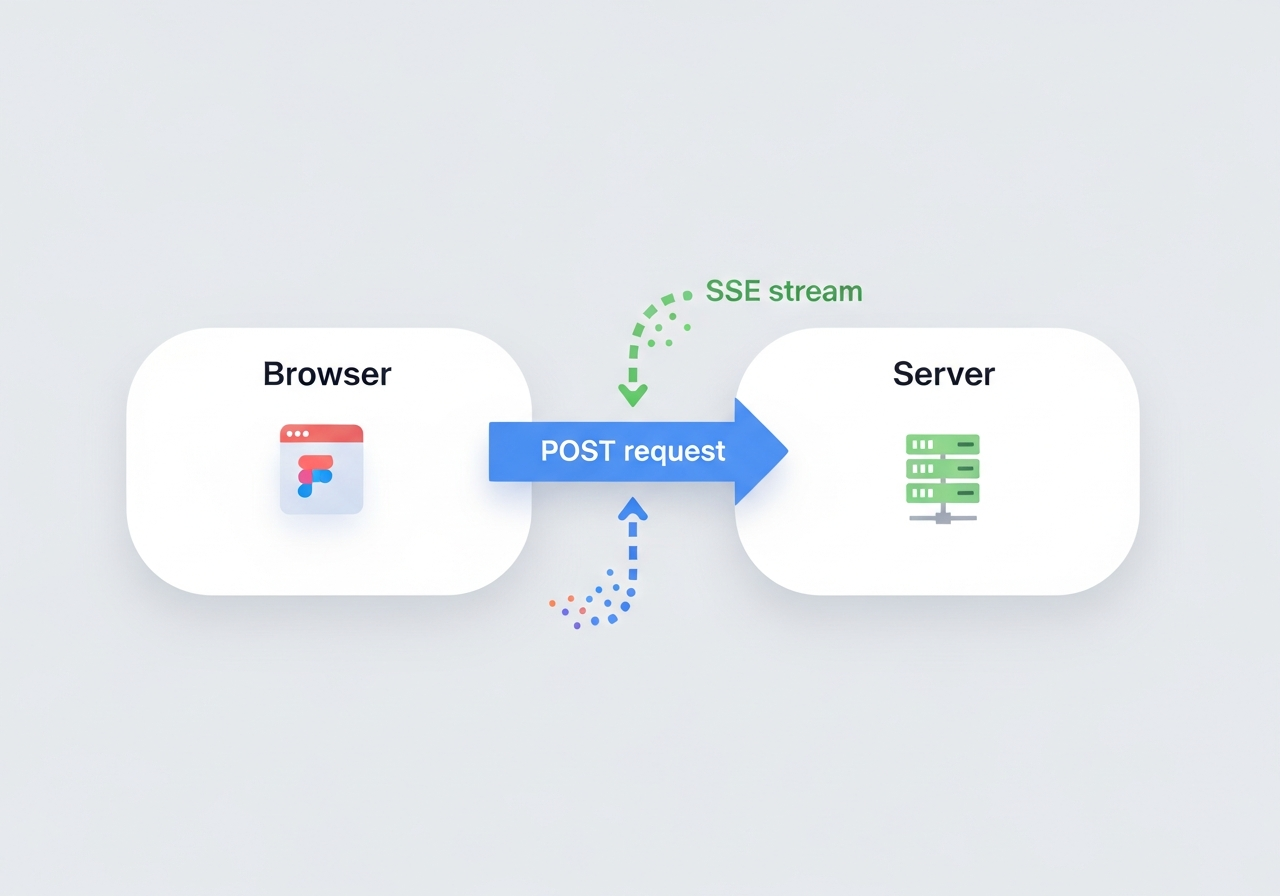 Our streaming layer: the browser sends a POST request with the full conversation state, and the server streams back AG-UI events over SSE -- text deltas, tool calls, and state snapshots.
The core pattern is surprisingly simple. AG-UI events are JSON payloads streamed over SSE. You do not need a framework to parse them.
function parseSSELines(chunk: string): AGUIEvent[] {
  const events: AGUIEvent[] = [];
  for (const line of chunk.split("\n")) {
    const trimmed = line.trim();
    if (trimmed.startsWith("data:")) {
      const json = trimmed.slice(5).trim();
      if (json && json !== "[DONE]") {
        try { events.push(JSON.parse(json)); } catch {}
      }
    }
  }
  return events;
}
The connection uses fetch with a ReadableStream, not EventSource. This matters because EventSource only supports GET requests. AG-UI requires POST with a JSON body.
const response = await fetch("/v3/agent", {
  method: "POST",
  headers: { "Content-Type": "application/json", Accept: "text/event-stream" },
  body: JSON.stringify({
    runId: crypto.randomUUID(),
    threadId: threadIdRef.current,
    messages: allMessages,
    state: agentState,
    tools: [],
    context: [],
    forwardedProps: {},
  }),
});

const reader = response.body.getReader();
Our entire streaming layer lives in a single React hook called useAgentStream. It returns:
const {
  messages,      // ChatMessage[] with interleaved content blocks
  agentState,    // { steps, files_created, preview_url, project_name }
  isStreaming,    // boolean
  sendMessage,   // (text, images?) => Promise<void>
  clearMessages, // () => void (generates new threadId)
} = useAgentStream();
What We Got
Going custom gave us things we could not get from a framework:
- ContentBlocks for interleaved rendering. Each assistant message contains ordered blocks of
{ type: "text" }and{ type: "tool_call" }. Text streams in, a tool card appears inline, more text streams after it. - Per-tool STATE_SNAPSHOT merging. When
write_filefires,files_createdaccumulates via Set union. Whenplan_task_stepsfires,stepsreplaces entirely. Whenstart_dev_serverfinishes,preview_urloverwrites. Each tool has its own merge strategy. - Generative UI via state events. The agent calls
search_images, the backend emits aSTATE_SNAPSHOTwithcustom_ui_components, and the frontend renders an<ImageGrid />inline in the chat. No framework extension points needed. - Multimodal support. Images pasted into chat are converted from AG-UI
BinaryInputContentto the agent's native format in the state context builder. One function, twelve lines. - Silent failure detection. If the SSE stream closes without a
RUN_FINISHEDorRUN_ERRORevent (e.g., expired credentials causing an abrupt disconnect), we surface a helpful error instead of showing nothing.
Total size: ~500 lines of TypeScript. Zero external dependencies beyond React.
Should You Do This?
Honest take:
- If your agent is text-in, text-out with basic tool calls and you do not need fine-grained state control: use CopilotKit. It handles the common case well and saves real time.
- If you need any of the following, consider going custom:
- Inline tool call cards interleaved with streaming text
- Per-tool state merge strategies
- Generative UI (agent-rendered React components)
- Multimodal input (images)
- Custom error handling and reconnection logic
- Full visibility into raw AG-UI events
The AG-UI protocol is well-designed enough that you do not need a framework to use it. A fetch call, a line parser, and a switch statement on event types gets you 90% of the way there.
The remaining 10% is where your app gets interesting.
References